Best Home EV Chargers: 6 Level 2 Picks for Your Garage (2026)
Affiliate disclosure: RiderMojo may earn a commission from qualifying purchases, including as an Amazon Associate, at no extra cost to you.
If you own an electric car, a Level 2 home EV charger is the single upgrade that changes daily life the most. The Level 1 cord that comes with most EVs plugs into a regular 120V outlet and adds only a few miles of range per hour. A 240V Level 2 charger can add roughly 25 to 45+ miles of range per hour, depending on the charger and your car, so you wake up to a full battery even after a long day of driving.
Below are six Level 2 home chargers that were available on Amazon when we checked in late October 2026, from a no-app plug-in workhorse to smart 48A and 50A units.
From the driver’s seat: RiderMojo’s founder spent years driving rideshare full-time in a 2019 Nissan Leaf here in Indianapolis. About $5 of electricity covered roughly 250 miles, and thanks to regenerative braking the car went 200,000 miles on its original brake pads. (Indy’s potholes finally retired it, not the battery.) Today he drives a Chevy Bolt, and over the years he has reviewed both home chargers and on-the-road fast chargers.
How we picked: We did not hands-on test these specific units for this article. We compared each Amazon listing’s specifications (amperage, plug or hardwired install, cable length, certifications, smart features and warranty), checked that each listing was live and available, and used U.S. Department of Energy guidance on home charging. Charging-speed figures are the manufacturers’ claims and depend on your vehicle.
Watch the Quick Video Guide
Quick Picks: Best Level 2 Home EV Chargers at a Glance
| Charger | Best for | Key spec | Where to buy |
|---|---|---|---|
| Emporia Level 2 EV Charger | Best overall smart value | 48A, 25 ft cable, Wi-Fi, ENERGY STAR | Check price on Amazon |
| ChargePoint HomeFlex | Best app and plug-in option | NEMA 14-50 plug, 23 ft cable, 16–50A adjustable | Check price on Amazon |
| Grizzl-E Classic | Best simple, rugged charger (no app) | 40A, 24 ft cable, metal case, IP67 | Check price on Amazon |
| Autel MaxiCharger | Best for maximum speed | 50A / 12 kW, 25 ft cable, Wi-Fi + Bluetooth | Check price on Amazon |
| Wallbox Pulsar Plus | Best compact design | 48A / 11.5 kW, about 8″ square | Check price on Amazon |
| Enphase IQ 40 | Best warranty | 32A, 5-year warranty, NEMA 4 enclosure | Check price on Amazon |
Short answer: For most EV owners, the Emporia 48A is the best mix of speed, smart features and value. If you already have (or want) a NEMA 14-50 outlet and a polished app, get the ChargePoint HomeFlex. If you just want a tough charger that works with no Wi-Fi and no account, the Grizzl-E Classic is the one owners keep recommending.
First, How Fast Does Your Car Actually Charge?
A home charger can only deliver as much power as your car’s onboard charger accepts. For example, the 2019 Nissan Leaf’s onboard charger is rated at 6.6 kW, so any 32A charger already maxes it out. Depending on model year, a Chevy Bolt accepts roughly 7.2 kW to 11.5 kW. Check your owner’s manual or the manufacturer’s spec sheet before choosing an amperage.
As a rough guide, a 32A charger delivers about 7.7 kW, a 40A charger about 9.6 kW, and a 48A charger about 11.5 kW on a 240V circuit. Because EV charging is treated as a continuous load under the National Electrical Code, the circuit breaker has to be rated at 125% of the charger’s output: 32A needs a 40A circuit, 40A needs a 50A circuit, and 48A needs a 60A circuit.
Watch: State Of Charge explains how many amps you really need for home EV charging, which is the best place to start before buying.
1. Emporia Level 2 EV Charger (48A) — Best overall smart value
Emporia’s 48A charger hits the sweet spot for most garages. It is preconfigured for a hardwired install with a whip and delivers up to 48 amps, which Emporia says adds up to 46 miles of range per hour, up to nine times faster than a standard wall outlet.
Over 2.4 GHz Wi-Fi, the Emporia app shows real-time energy data and lets you schedule charging for off-peak utility rates. Emporia lists UL and ENERGY STAR certification and standards including SAE J1772, UL 2594 and NEC 625, and backs it with a 3-year warranty. It uses the J1772 connector; if you drive a Tesla or a newer NACS-port EV, Emporia sells a separate NACS version.
Key specs
- Output: up to 48A (about 11.5 kW) at 240V
- Charging speed: up to 46 miles of range per hour (Emporia claim)
- Install: hardwired with whip
- Cable: 25 ft, J1772 connector (NACS version sold separately)
- Smart features: 2.4 GHz Wi-Fi, app scheduling, real-time energy data
- Certifications: UL listed, ENERGY STAR
- Warranty: 3 years
Pros
- Full 48A speed for cars that can use it
- Energy tracking and off-peak scheduling
- Long 25 ft cable and holster included
- Strong value for a smart charger
Cons
- Hardwired only, so plan on an electrician
- Wi-Fi is 2.4 GHz only
- 48A requires a 60A circuit
Best for: Most EV owners who want a fast, smart charger without paying premium-brand prices.
2. ChargePoint HomeFlex (NEMA 14-50) — Best app and plug-in option
ChargePoint runs one of the largest public charging networks in North America, and the HomeFlex brings that polish home. This version plugs into a 240V NEMA 14-50 outlet on a 40A or 50A circuit. ChargePoint says it charges about nine times faster than a 120V outlet and adds up to 45 miles of range per hour, depending on the vehicle.
The ChargePoint app is the main draw: schedule charging, connect smart home devices, see charging data and find public stations on road trips with the same app. The listing notes amperage settings from 16 to 50A, a 23-foot cold-resistant cable, UL certification, ENERGY STAR and indoor/outdoor installation. On a plug-in install your electrician will cap output at what the outlet circuit allows; if you want the full 50A, ChargePoint also sells a hardwired 50A HomeFlex.
Key specs
- Output: adjustable 16–50A (plug-in limited by your circuit)
- Charging speed: up to 45 miles of range per hour (ChargePoint claim)
- Install: NEMA 14-50 plug-in (hardwired version available)
- Cable: 23 ft, cold-resistant, J1772 (Tesla needs adapter)
- Smart features: ChargePoint app, scheduling, smart home integration
- Certifications: UL, ENERGY STAR
- Weight/warranty: 13.8 lb; 3-year parts warranty
Pros
- Excellent, mature app shared with the public network
- Plug-in install is easy to move later
- Flexible amperage for almost any circuit
- 24/7 support
Cons
- Usually priced above simpler chargers
- Cable is 2 ft shorter than most rivals
- Full 50A needs the hardwired model
Best for: Drivers who value a polished app, or renters and movers who want a plug-in charger.
3. Grizzl-E Classic (40A) — Best simple, rugged charger
The Grizzl-E Classic from United Chargers is a heavy-duty charger with a metal enclosure and no Wi-Fi at all: plug in and it charges. It plugs into a NEMA 14-50 outlet and comes with a 24-foot premium cable designed for normal and cold weather, and it works with all EVs and plug-in hybrids sold in North America (Tesla owners need an adapter).
Amperage is adjustable to match your circuit: 40A on a 50A breaker, 32A on 40A, 24A on 30A or 16A on 20A. Grizzl-E quotes about 28–30 miles of range per hour at 40A. It is UL tested and certified and IP67 water resistant, with a built-in GFCI, multiple electrical protections and automatic recovery after a power outage.
Key specs
- Output: 40A max, adjustable to 32A, 24A or 16A
- Charging speed: about 28–30 miles of range per hour at 40A (Grizzl-E claim)
- Install: NEMA 14-50 plug
- Cable: 24 ft
- Build: metal case, IP67, indoor/outdoor
- Safety: UL certified; built-in GFCI; power-outage recovery
- Weight: 16.6 lb
Pros
- Tough metal enclosure suits garages and driveways
- No app, account or Wi-Fi to fail
- Adjustable amperage for smaller circuits
- Long 24 ft cable
Cons
- No scheduling (use your car’s own timer instead)
- 40A max is slower than 48A units
- Heavier than most chargers here
Best for: Drivers who want a set-and-forget charger, or garages with weak Wi-Fi.
4. Autel MaxiCharger (50A) — Best for maximum speed
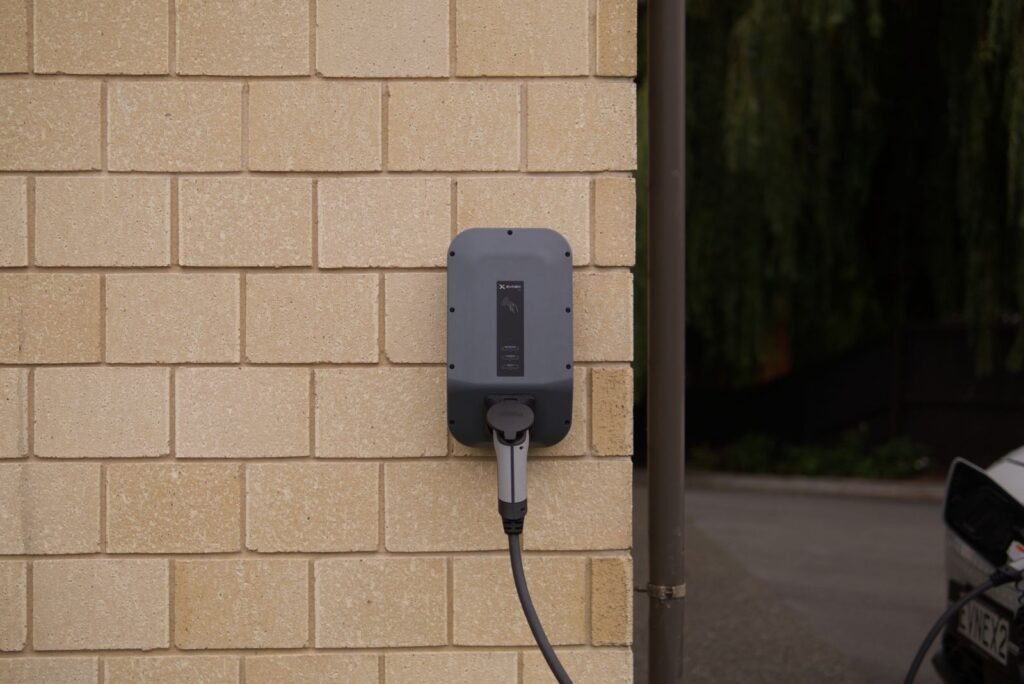
Autel’s MaxiCharger AC Home is one of the most powerful home chargers on Amazon. This hardwired model delivers up to 50A (12 kW), adjustable from 16 to 50A. Autel’s listing quotes about 37 miles of range per charging hour in one place and up to 46 miles per hour in another; the real number depends on what your car can accept.
For outdoor installs, the enclosure is NEMA Type 4 rated for rain, snow, hail and sleet, and the 25-foot cable is designed to stay flexible down to -40°. You get Wi-Fi, Bluetooth and Ethernet connectivity, over-the-air firmware updates and the Autel Charge app for scheduling off-peak charging. Autel lists CSA certification and a 3-year warranty.
Key specs
- Output: up to 50A (12 kW), adjustable 16–50A
- Charging speed: about 37–46 miles of range per hour (Autel claims)
- Install: hardwired
- Cable: 25 ft, rated flexible to -40°
- Connectivity: Wi-Fi, Bluetooth, Ethernet; OTA updates; app scheduling
- Rating: NEMA Type 4; CSA certified
- Warranty: 3 years
Pros
- Highest output in this guide
- Built for outdoor and cold-weather installs
- Three ways to connect, including Ethernet
- Adjustable amperage
Cons
- 50A needs a 70A circuit, which many homes can’t spare
- Only worth it if your car accepts 11.5 kW or more
- Hardwired install required
Best for: EVs with large batteries and fast onboard chargers, and outdoor or cold-climate installs.
5. Wallbox Pulsar Plus (48A) — Best compact design
The Pulsar Plus is tiny for a 48A charger: at about 3.9 x 7.8 x 7.9 inches, it looks tidy on a finished garage wall. It delivers up to 48A (about 11.5 kW), which Wallbox says adds up to 45 miles of range per hour, and it uses a standard J1772 connector (Tesla models need an adapter).
Wi-Fi and Bluetooth let you monitor, control and schedule every session through the Wallbox app. It is UL and ENERGY STAR certified, rated for indoor and outdoor use, assembled in the U.S. and covered by a 3-year warranty. This 48A version is a hardwired install. (Wallbox also sells a 40A plug-in Pulsar Plus, but that Amazon listing showed no buying option when we checked.)
Key specs
- Output: up to 48A (about 11.5 kW)
- Charging speed: up to 45 miles of range per hour (Wallbox claim)
- Install: hardwired
- Size: about 3.9″ D x 7.8″ W x 7.9″ H
- Cable: 25 ft, J1772
- Smart features: Wi-Fi, Bluetooth, app scheduling
- Certifications/warranty: UL, ENERGY STAR; 3 years
Pros
- Very compact and clean-looking
- Full 48A output
- Good app with scheduling
- Solar-friendly
Cons
- Hardwired only at 48A
- Limited stock on the listing when we checked
- No NACS plug on this version
Best for: Owners who care about looks and wall space as much as charging speed.
6. Enphase IQ 40 (32A) — Best warranty
The IQ 40 comes from Enphase, which took over ClipperCreek, a brand long known for durable chargers. It is a 32A unit that needs a 40A circuit and delivers up to about 7.7 kW, which Enphase says adds up to 31 miles of range per hour. That is all many EVs and plug-in hybrids can accept anyway, including the 2019 Leaf mentioned above.
Its standout is the 5-year limited warranty, the longest here. The enclosure is sealed and NEMA 4 rated, it is UL 2594 safety certified and ENERGY STAR certified, and the Enphase app handles schedules and off-peak reminders. It can also pair with Enphase solar systems.
Key specs
- Output: 32A (about 7.7 kW); requires a 40A circuit
- Charging speed: up to 31 miles of range per hour (Enphase claim)
- Install: hardwired
- Cable: 25 ft, J1772
- Smart features: Wi-Fi, Enphase app scheduling, solar pairing
- Certifications: UL 2594, ENERGY STAR; NEMA 4 enclosure
- Warranty: 5-year limited
Pros
- Longest warranty here
- Smaller 40A circuit is easier to fit in older panels
- Proven ClipperCreek design heritage
- Pairs with Enphase solar
Cons
- Slower than 40A–50A chargers
- Hardwired only
- Low stock on the listing when we checked
Best for: Older electrical panels, plug-in hybrids and EVs with 7.7 kW or smaller onboard chargers.
Buyer’s Guide: How to Choose a Level 2 Home EV Charger
1. Match the amperage to your car and your panel
Look up your EV’s maximum AC charging rate and buy a charger that matches it, not the biggest one available. Then have an electrician check whether your electrical panel has room for the circuit. A 32A or 40A charger on a 40A or 50A circuit covers most drivers, and it is often far cheaper to install than a 60A or 70A circuit, especially in older homes.
2. Plug-in or hardwired?
Plug-in chargers use a NEMA 14-50 outlet and are easy to take with you when you move. Hardwired chargers connect directly to the circuit, can run at 48A or more, and avoid wear on an outlet. Either way, use a licensed electrician: charging is a continuous load, and a cheap or worn outlet can overheat. The U.S. Department of Energy also recommends safety-certified equipment, such as ENERGY STAR certified chargers, and notes that permits may be required.
3. Smart or simple?
Smart chargers let you schedule charging for cheaper overnight rates, track energy use and sometimes qualify for utility programs. Many EVs can schedule charging themselves, though, so a simple charger works fine if you don’t need the data.
4. Cable length and connector
Measure from the mounting spot to your charge port, with extra slack for parking either way. If it will live outside, choose an outdoor rating such as NEMA 4 or IP67. Most non-Tesla EVs still use the J1772 plug, but many new models are moving to the NACS (Tesla-style) port, so check your car and consider a NACS version or a quality adapter.
5. Incentives and rebates
The federal 30% home charger tax credit (up to $1,000) applied to equipment placed in service at your main home through June 30, 2026, according to the IRS, so new installs today generally won’t qualify. Many utilities and states still offer their own rebates or off-peak EV rates, so check with your electric company before you buy.
Watch: EV Pulse breaks down who really needs Level 2 charging at home and who can get by on Level 1.
Want more background? Our guides to charging time for electric cars and charging at home and on the road cover the basics.
Home EV Charger FAQ
Do I need a Level 2 charger at home?
Not always. The DOE notes that many drivers meet their daily needs by charging overnight on Level 1. Level 2 makes sense if you drive a lot (rideshare drivers especially), have a long commute, a large battery, or an irregular schedule that leaves less time to charge.
How many miles per hour does a Level 2 charger add?
It depends on the charger and the car, but the chargers here quote roughly 25 to 46 miles of range per hour. Your car’s onboard charger sets the upper limit, so a 48A charger won’t charge a 6.6 kW car any faster than a 32A unit.
Is 40 amps or 48 amps better?
A 48A charger is faster only if your car can accept about 11.5 kW. If your car tops out around 7–9.6 kW, a 32A or 40A charger is plenty and usually needs a smaller, cheaper circuit.
Will a J1772 charger work with a Tesla or a NACS-port EV?
Yes, with a J1772-to-NACS adapter. Several brands, including Emporia and Grizzl-E, also sell native NACS versions of their chargers.
Does a home charger save money compared with public fast charging?
Usually, yes. Home electricity is typically far cheaper per kWh than DC fast charging. In our founder’s Leaf, about $5 of electricity covered roughly 250 miles, though your cost depends on your utility rate and your car’s efficiency.
Final Thoughts
The best Level 2 home EV charger is the one that matches your car, your panel and how you like to manage charging. For most drivers, the Emporia 48A is our top pick. Choose the ChargePoint HomeFlex for the best app and a plug-in install, the Grizzl-E Classic for a tough no-app charger, or the Enphase IQ 40 if your panel can only spare a 40A circuit.
Before you order, check your car’s onboard charging rate, get an electrician’s quote, and confirm current pricing on Amazon.
Subscribe to Driver Mojo on YouTube for more EV, scooter and e-ride content.
Sources
- U.S. Department of Energy, Alternative Fuels Data Center — Charging Electric Vehicles at Home
- IRS — Alternative Fuel Vehicle Refueling Property Credit
- Manufacturer specifications from each product’s Amazon listing, checked October 30, 2026