Best Replacement E-Bike Batteries (2026): 6 Downtube, Hailong and Rear-Rack Packs Compared
Affiliate disclosure: RiderMojo may earn a commission from qualifying purchases, including as an Amazon Associate, at no extra cost to you.
An e-bike battery does not last forever. After a few hundred charge cycles, a few hard winters or one bad drop, you start to notice shorter rides, voltage sag on hills or a pack that will not hold a charge. Factory replacements can be pricey or out of stock, which is why so many riders end up shopping for an aftermarket battery on Amazon.
That can work well, but only if the new pack actually matches your bike. Voltage, connector, battery base (mount), BMS current rating and physical size all have to line up, and fire safety matters more here than with almost anything else you can bolt onto a bike. Below are six real replacement batteries sold on Amazon right now, from 36V commuter packs to 52V high-power packs and a rear-rack option, plus a buyer’s guide on what to check before you click buy.
A quick note on where we are coming from: I spent years driving electric rideshare full time, with more than 16,000 Uber rides and 200,000 miles in a 2019 Nissan Leaf, so I have lived with lithium batteries every day. We have not bench-tested the packs below. Specs come from each product listing, and we tell you where to double-check them.
Watch the Quick Video Guide
Quick picks
| Pick | Best for | Voltage / capacity | Style / connector |
|---|---|---|---|
| Unit Pack Power 48V 20Ah | Best overall 48V | 48V 20Ah (960Wh) | Downtube, XT60 |
| Leonidas 52V 25Ah | Best 52V with UL 2271 claim | 52V 25Ah (1300Wh) | Downtube, XT60 |
| Hawkvium 52V 25Ah | Best for high-power motors | 52V 25Ah (1300Wh) | Downtube, 5-pin base, XT60 + XT90 |
| UUGPOWER 36V 10.4Ah | Best budget 36V | 36V 10.4Ah (about 374Wh) | Hailong-style downtube, XT60 |
| YOSE POWER 48V 20.8Ah Rear Rack | Best rear-rack battery | 48V 20.8Ah (about 998Wh) | Rear rack, Anderson |
| YOSE POWER 48V 14Ah for Rad | Best brand-specific swap | 48V 14Ah (672Wh) | Fits existing Rad base |
1. Unit Pack Power 48V 20Ah: best overall 48V replacement
Unit Pack Power (UPP) is one of the most common names you will see in DIY e-bike forums, and this 48V 20Ah downtube pack is a popular choice for Bafang BBS02 and BBSHD mid drives and 48V hub kits. It comes with a battery base, a lock with keys and an LED charge indicator. The listing says each pack goes through a full charge and discharge test before shipping.
Key specs (from the Amazon listing)
- 48V 20Ah with LG-brand cells; listed for 50W–1500W motors
- 40A max continuous discharge
- XT60 discharge connector (male and female side)
- About 365 x 90 x 110 mm
- Includes a 54.6V 2A charger
- Listing claims 1,000+ cycles and at least 80% capacity after 800 cycles; 1-year support with a US-based tech team
Pros
- Name-brand cells and a well-known seller in the DIY scene
- 20Ah gives roughly 960Wh, plenty for long commutes
- Lock, base and charger included
- Common XT60 connector works with most kits
Cons
- The listing does not claim UL 2271 certification
- 2A charger is slow for a 20Ah pack
- Check the base pin layout and frame space before buying
Best for: most 48V conversion-kit and hub-motor bikes that need a big, dependable downtube pack.
2. Leonidas 52V 25Ah: best 52V pack with UL 2271 certification
If your controller is rated for 52V, a 52V battery gives a bit more top-end speed and less voltage sag than a 48V pack. The Leonidas 52V 25Ah is listed as UL 2271 certified and uses LG 21700 cells, with a 50A BMS that suits higher-power hub and mid drives. It also has an on/off switch, which is handy for stopping standby drain when the bike is parked.
Key specs (from the Amazon listing)
- 52V 25Ah (about 1300Wh), LG 21700 cells
- Listed for 100W–2000W motors
- 50A BMS, 50A max continuous discharge
- XT60 discharge connector (male and female side)
- LED indicator, safety lock and power switch
- About 14.4 x 3.7 x 6.1 inches; battery weight listed at 5 kg
- 1-year warranty, US-based tech support
Pros
- UL 2271 certification is stated in the listing title
- Big 25Ah capacity for long range
- 50A BMS headroom for 1000W+ motors
- Power switch helps storage
Cons
- Only for controllers rated for 52V (about 58.8V fully charged)
- Heavier and taller than a 36V or 48V pack, so check frame clearance
- Listing showed low stock when we checked
Best for: riders with a 52V-ready controller who want long range and a safety certification on the label.
Wondering whether 52V is worth it on your bike? This explainer from Golden Motor walks through the real difference between 48V and 52V packs:
3. Hawkvium 52V 25Ah: best for high-power and dual-motor builds
Hawkvium’s 52V 25Ah pack is aimed at riders pushing serious power. The listing pairs Grade-A 21700 cells with a 60A BMS and covers motors up to 3000W, and it ships with both XT60 and XT90 female discharge cables so it can work with single- and dual-motor setups. It comes pre-mounted on a 5-pin base, and the listing title says it is SGS-tested to UL 2271.
Key specs (from the Amazon listing)
- 52V 25Ah (listed as 1300Wh), Grade-A 5000mAh 21700 cells
- 60A BMS; listed for 100W–3000W motors
- XT60 and XT90 female discharge cables, 5-pin base
- 14.49 x 3.54 x 5.94 inches, 13.23 lb
- Safety lock, LED indicator, power switch, waterproof case, anti-vibration pads
- Listing claims 1,000+ cycles and at least 80% capacity after 800 cycles
Pros
- Highest BMS current rating in this list
- XT90 option for high-current controllers
- UL 2271 (SGS) is stated in the title
- Ships attached to the base for easy mounting
Cons
- Overkill for a 250W–500W commuter
- 52V only, so your controller must support it
- Newer brand with less track record than UPP
Best for: 1500W+ builds, dual-motor bikes and riders who keep blowing fuses on smaller packs.
4. UUGPOWER 36V 10.4Ah: best budget 36V replacement
Plenty of older and entry-level e-bikes run on 36V, and many of them use Hailong-style downtube packs. This UUGPOWER 36V 10.4Ah battery is a modest, lighter replacement that the listing says has passed UL 2271 testing. It is offered with both 4-pin and 5-pin bases, which matters a lot (more on that in the buyer’s guide).
Key specs (from the Amazon listing)
- 36V 10.4Ah (about 374Wh); listed for 0–750W motors
- 30A continuous discharge, 75A instant peak
- XT60 plug, USB port, LED indicator, safety lock
- About 14.5 x 3.74 x 3.5 inches
- 4-pin or 5-pin base options
- 1-year warranty
Pros
- UL 2271 certification claimed in the listing
- Slim and light compared to 20Ah packs
- Choice of base pin layouts
Cons
- 10.4Ah means shorter range than the big packs here
- Only for 36V systems
- You must order the right base pin count
Best for: 36V commuters and older e-bikes that just need their range back.
5. YOSE POWER 48V 20.8Ah Rear Rack: best rear-rack battery
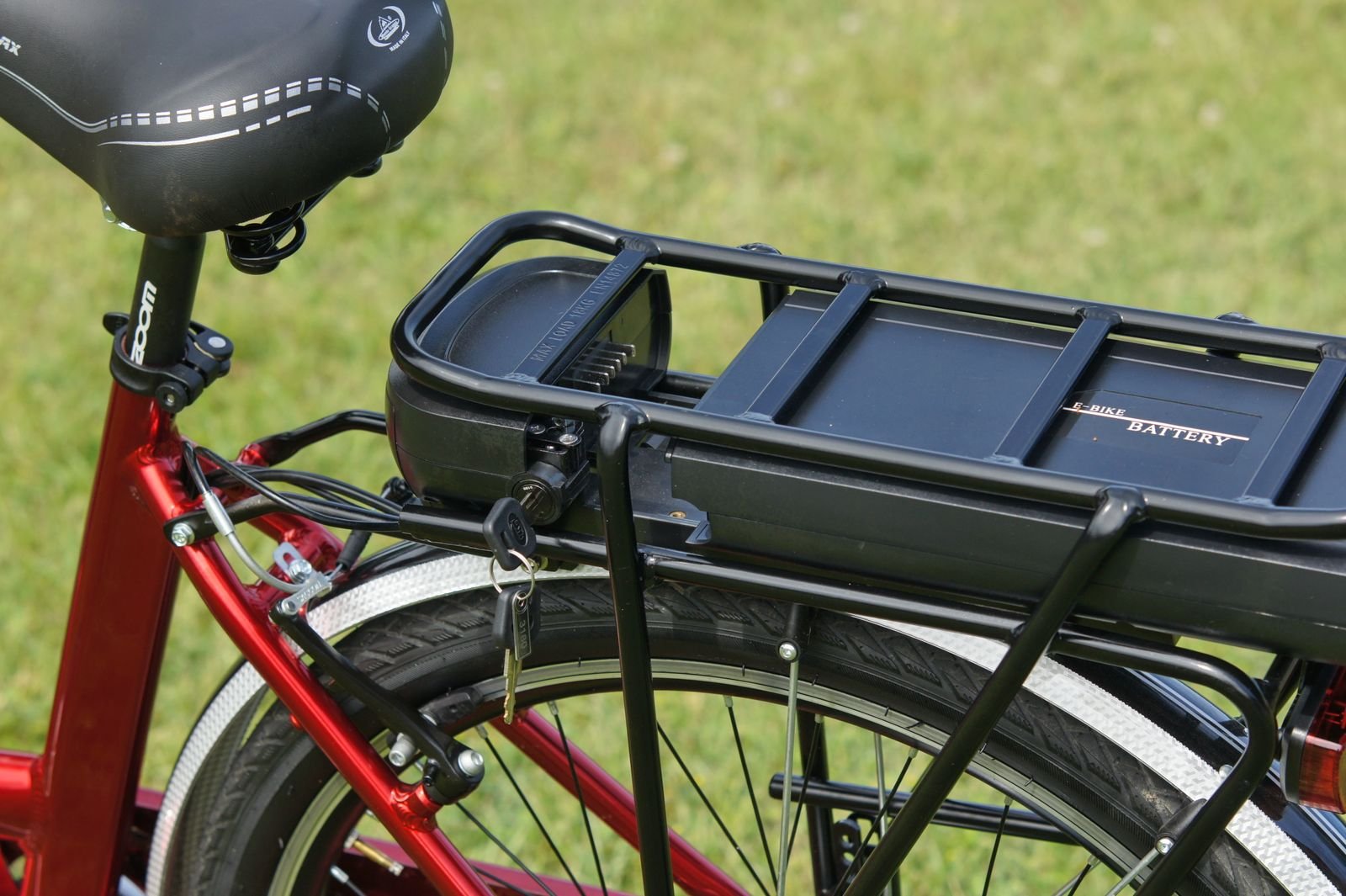
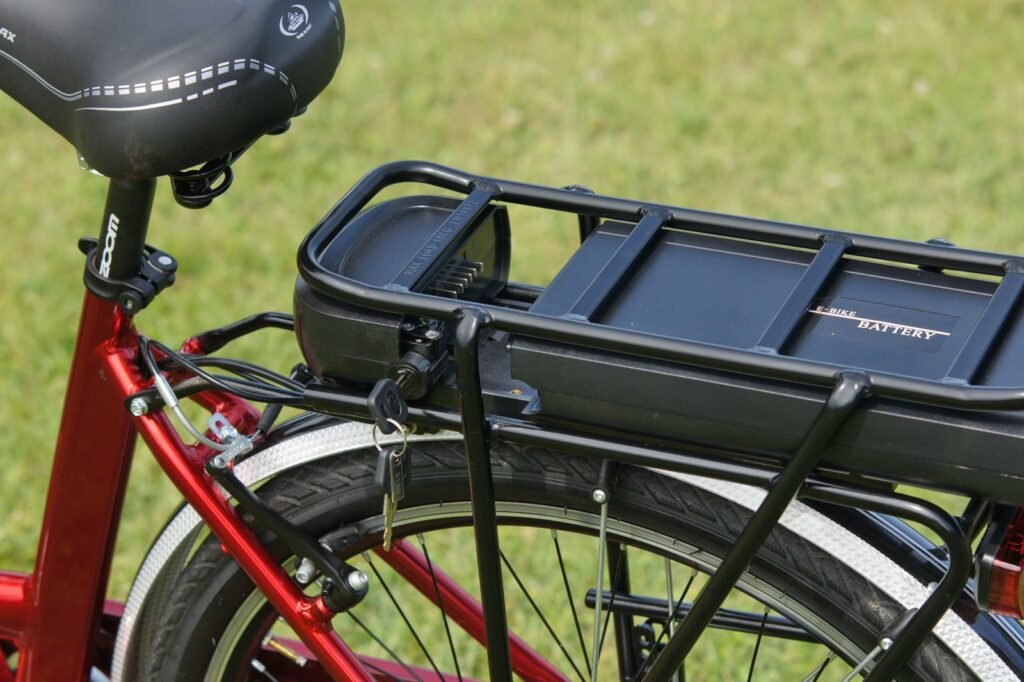
Step-through and city bikes often carry the battery under the rear rack, like the bike in our photo above. YOSE POWER’s 48V 20.8Ah rack pack includes the rack-style battery holder base, a 3A charger, spare fuses and an extra Anderson connector adapter, so it can also be a good choice for conversions where there is no room on the downtube.
Key specs (from the Amazon listing)
- 48V 20.8Ah, 13S8P with grade-A cells
- 40A BMS (70A protection current); listed for 250W–1500W motors
- Anderson discharge connector with extra adapter; 10A charge and 50A discharge spare fuses
- USB output 5V 1A
- 54.6V 3A charger, about 7 hours to charge
- Battery weight listed at 14.3 lb; case about 427 mm long
- 18-month warranty
Pros
- Frees up the frame on small or step-through bikes
- Faster 3A charger included
- Spare fuses and adapter in the box
- Longest warranty in this list
Cons
- Weight sits high and to the rear, which affects handling
- Rack mounts vary, so measure before buying
- No UL 2271 claim on the listing
Best for: step-through, cruiser and cargo bikes, and conversions with no downtube space.
6. YOSE POWER 48V 14Ah for Rad Power Bikes: best brand-specific replacement
If you own a factory e-bike, the safest bet is usually a pack built to match that model. This YOSE POWER battery is made to slide onto the existing base of many Rad Power Bikes models, so there is no rewiring. It ships with a holder base already installed (you can remove it), keys and a manual, but no charger, since you already have one.
Key specs (from the Amazon listing)
- 48V 14Ah (672Wh)
- Listed as compatible with 2018-and-newer Rad models including RadRunner, RadRunner Plus, RadWagon, RadMini, RadRover 4 and older and RadCity 4 and older
- Not compatible with RadRover 6 Plus, RadCity 5 Plus, RadRunner 3 Plus or RadMission
- BMS with over-charge, over-discharge, over-current and short-circuit protection
- LED level light and safe lock; battery weight 8.7 lb
- 18-month warranty; charger not included
Pros
- Drop-in fit on your existing Rad base
- No connector or wiring changes
- Clear compatibility list in the listing
Cons
- Not for newer Rad models listed above
- No charger included
- This listing does not claim UL 2271
Best for: Rad owners on a supported model who want the simplest swap.
Buyer’s guide: how to match a replacement e-bike battery
1. Match the voltage to your controller
Voltage is the one spec you cannot fudge. Match the nominal voltage on your current battery or controller label: 36V packs charge to about 42V, 48V to about 54.6V and 52V to about 58.8V. A 52V pack on a 48V-only controller can trip low-voltage settings or damage components, so only go up in voltage if your controller and display are rated for it. Never put a 48V pack on a 36V system unless the manufacturer says it is supported.
2. Capacity (Ah) and watt-hours set your range
Amp-hours tell you how much charge the pack holds at its voltage. Multiply volts by amp-hours to get watt-hours (48V x 20Ah = 960Wh), which is the best number for comparing range between packs. More capacity means more range, but also more weight and a bigger case, so measure before you upgrade.
3. Check the BMS current rating against your motor
The battery management system (BMS) protects the cells from over-charge, over-discharge, short circuits and too much current. Its continuous rating should be at least as high as your controller’s max current. A 20A or 30A BMS is fine for many 500W–750W systems; 1000W+ motors usually need 40A–60A. If the BMS is too small, the pack will cut out under hard acceleration or on hills.
4. Match the connector and the base pins
Most aftermarket packs use XT60 plugs, with XT90 or Anderson connectors on higher-current or rack batteries. Hailong-style downtube packs also use a base with 4, 5 or 6 pins, and the pin layout has to match the battery you order. If your old base and new pack do not match, use the new base that comes with the battery. Avoid cheap adapters or twisting wires together, since a poor connection can overheat.
5. Match the mount and physical size
Downtube, Hailong “shark”, “silverfish” seat-tube and rear-rack packs all mount differently. Measure the space on your frame, including clearance to the seat tube and bottle bosses, and compare it to the listed case size. If you own a factory e-bike, a model-specific replacement like the Rad pack above is usually the easiest and safest swap.
6. Look for UL 2271 or UL 2849 and take fire safety seriously
UL 2271 is the safety standard for batteries used in light electric vehicles like e-bikes and scooters. UL 2849 covers the whole e-bike electrical system: battery, charger and motor tested together. A replacement battery on its own can only be UL 2271 certified; UL 2849 applies to complete bikes. Cities like New York now require these certifications for e-bikes and batteries sold there. When a listing claims certification, look for the testing lab name (such as UL, SGS or ACT) and ask the seller for the certificate if you are unsure.
Even a certified battery needs safe habits. U.S. fire safety agencies give the same basic advice:
- Use the charger made for your battery’s voltage and chemistry
- Charge where you can keep an eye on it, not overnight in a bedroom or blocking an exit
- Keep batteries out of extreme heat and do not charge a frozen pack
- Stop using any battery that is swollen, leaking, smells odd, makes noise or gets very hot
- Never open, rebuild or puncture a pack, and recycle old ones at a battery drop-off, never in household trash
This EbikeSchool.com video explains what UL listing really means for e-bikes and batteries, and why it is worth paying attention to:
7. Warranty and seller support
Aftermarket packs usually come with a 1-year to 18-month warranty. Keep your receipt, test the pack as soon as it arrives and contact the seller right away if range seems far below what the listed watt-hours should give you.
FAQs
Can I put a 52V battery on a 48V e-bike?
Only if your controller, display and any lights are rated for 52V. A full 52V pack sits near 58.8V, which is above what some 48V controllers accept. Check your controller label or ask the bike or kit maker first.
How long does an e-bike battery last?
Most lithium-ion packs are rated for several hundred to 1,000+ full cycles. Several listings here claim at least 80% capacity after 800 cycles. Heat, deep discharges and storing the pack fully charged or empty all shorten its life.
Is a UL 2271 battery really safer?
A UL 2271 certification means the pack design passed a set of electrical, mechanical and fire tests. It does not make a battery fireproof, but it is a much better bet than an uncertified pack with no paper trail. Good charging and storage habits still matter.
What does the BMS rating mean?
It is the maximum continuous current the battery’s protection board allows. Pick a BMS rating at or above your controller’s current limit so the battery does not cut out under load.
Do I need a new charger with a replacement battery?
Use a charger that matches the new battery’s voltage and connector. Several packs here include one; the Rad-compatible YOSE pack does not, since it works with your existing Rad charger. Never use a 52V charger on a 48V battery or the other way around.
How should I store an e-bike battery for winter?
Store it indoors at room temperature, around half charged, and away from anything flammable. Check and top it up every month or two so it does not drain all the way down.
Bottom line
For most 48V conversion kits and hub-motor bikes, the Unit Pack Power 48V 20Ah is a safe, well-known starting point. If your controller supports 52V, the Leonidas 52V 25Ah adds range and a UL 2271 claim, and the Hawkvium 52V 25Ah is the pick for high-power builds. Budget 36V riders should look at the UUGPOWER 36V 10.4Ah, rear-rack bikes at the YOSE POWER 48V 20.8Ah, and Rad owners at the model-matched YOSE POWER 48V 14Ah. Whatever you buy, match voltage, connector, base and BMS current first, and treat charging with the respect a big lithium battery deserves.